The Seahorse of Doom - A Look At Juba the Wicked
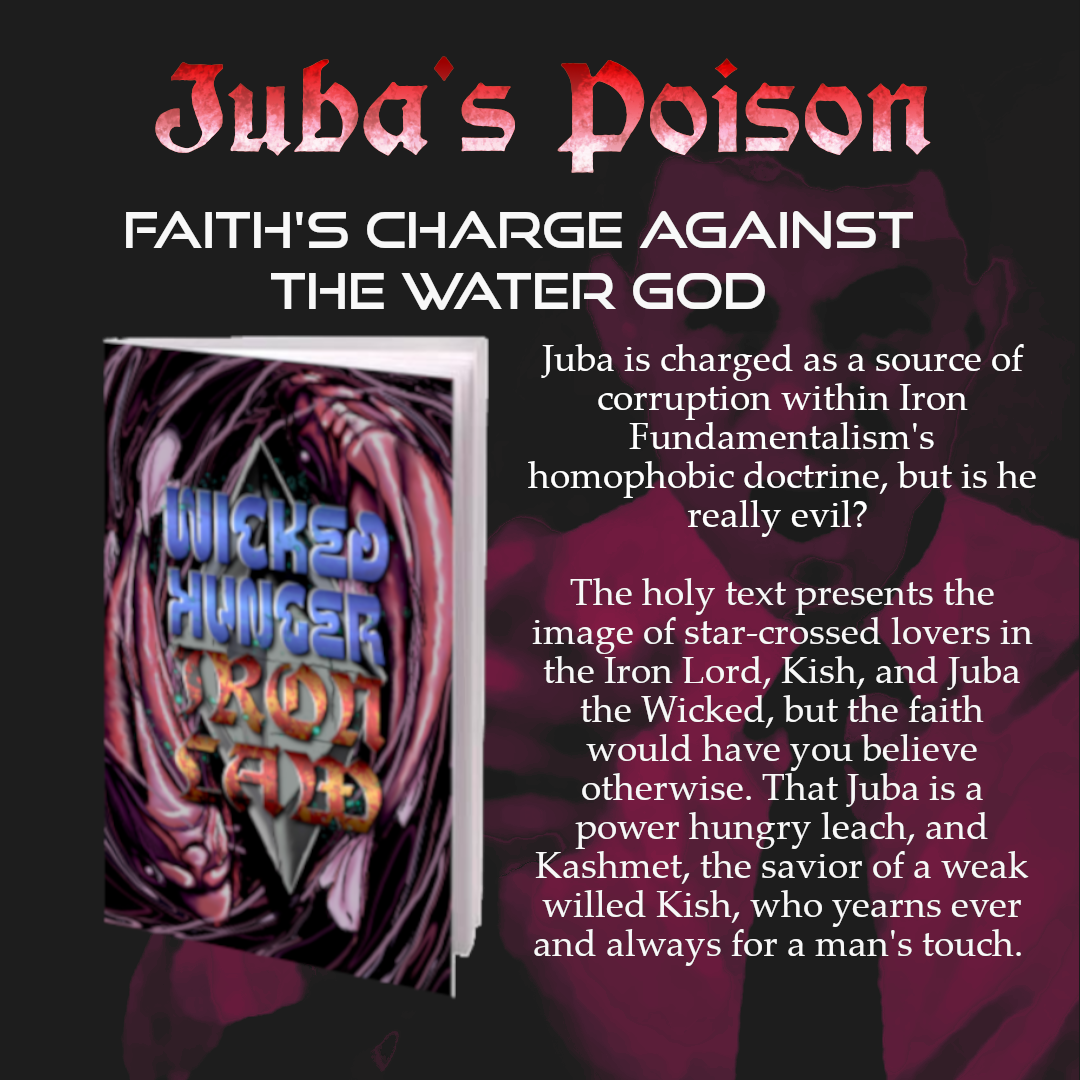
I've covered the relationship between the gods in Iron Fundamentalism in some detail in this post, but I want to take a closer look at one of them in particular. Juba is positioned as a polarizing figure in Wicked Hunger Iron Law, with devout worshippers viewing him as an evil trickster hellbent on dragging good men off the path to righteousness, up to and including the religion's supreme being, the Iron Lord, Kish. But I chose to frame this as a love story whenever the actual holy text references their relationship, or when references are made to what that holy text actually says. (I'm currently working on fleshing out the Book of the Earth more, by the way, and what I put together will eventually replace the current reader magnet you get for signing up for my newsletter). When I started writing this book, I set out to explore the internal incongruities in the faiths we choose to follow, and set a narrative framed around a desire to escape from these institutions against that backdrop.
There was a simple reason for doing so.
The Central Aberrations within Faith
For many of us queer people, religiosity is a source of trauma, because we spent our childhoods internalizing messages about a divine wrongness associated with our identities...so much so that we tried to change everything about ourselves to fit the stereotypical model of our sex. For gay men, that often means presenting ourselves as hyper distilled versions of the straight men we can never hope to become, becoming almost caricatures of masculinity, leaning into toxic traits while we yearn for the freedom to love who we love, and find ourselves searching through crowds for signs that someone else out there might secretly be like us.
What the Book of the Earth presents, and what Iron Fundamentalism claims to, are two wildly different images of the relationships between three gods. The dynamics of this holy trinity are intentionally left vague enough to invite interpretation, as this is the way most holy texts we encounter in our day to day lives are written. There is a reason there are dozens of denominations within Christianity. There, too, is a reason Buddhism has so many flavors. Religions that seek to convert the masses have a motivation to incorporate some of their beliefs into the official canon, and tend to do so as they spread, which leads to things like Bodhisattvas and visitations from the Virgin Mary, or yule time traditions becoming mainstream in Christianity, or the Christianization of other faiths like whatever they were calling Norse Mythology before it became mythologized. There is a drive within faiths of this nature to propel them forward even if it means temporarily or permanently introducing internal inconsistencies into the text and traditions themselves.
Hypocrisy and inconsistency are both through lines endemic to old world religions that have grown too bloated to sustain themselves in their singularly distilled forms, and proselytization inevitably leads to internal inconsistencies in the narratives of these religions, as different interpretations crop up, and beliefs from the entrenched faiths they encounter in populations they seek to convert are incorporated into them to make that transition more likely.
The Trickster Who Took Your Man Away
Juba is presented as a trickster hellbent on stealing away good men and ferrying them across his vast, underground lake to a fabled far shore which is populated by queer men, and which is presented as a kind of hellscape. The central irony is that the religion upholds the earliest days, before the creation of life, to have been a time of fire, when the world was a mass of molten rock and the stars were obscured behind clouds of thick ash. (Wicked Hunger Iron Law, His Poison, p. 101)
Juba presents, then, a tempering force. Water makes its way out of the ground and cools the earth's crust. Life already exists within his underground lake, because he is capable of creating it without need for anyone else's contribution, something neither Lord Kish nor Lady Kashmet is capable of. The faith bills this variety of life as cruel, because it relies on violence to sustain itself, but that violence sits at the core of a circle of life which simply establishes a food chain. Perhaps this is a cruel kind of life, but it does not exclude humans from the equation, and his hand is only involved in the creation of one such entity, the only one which contains the influences of all three of the gods in his form, who is nonetheless deemed an agent of Juba and positioned as almost an antichrist. (Wicked Hunger Iron Law, Luke, p. 9; The Red Light District, p. 50)
So, we have this god of water without whom the world would be completely inhospitable, a barren waste on which nothing could grow, and nothing could live. We have the underworld, where Juba lives, which is already teaming with life by the time water erupts onto the planet's surface, and the effects of water mingling with fire and earth ultimately create the conditions necessary for life to flourish, eventually leading to the creation of the first humans, whom Iron Fundamentalism calls either Inheritors of the Iron Will, or automatons, creating degrees of separation both between these near perfect first entities and ordinary humans, and between those creations and the floral, faunal, fungal and protozoal creations of Juba, "the Wicked".
See that distinction play out here, in this excerpt from an unreleased story I wrote while building out Iron Fundamentalism's orthodoxy.
“You have a name? A real name? Something they called you when you opened your eyes to the world, and saw the fire in the sky and the void at its heart, the shadows dancing among the trees, and heard the yowls and grunts of night beasts awakened on the day the moon rose with the sun, when the Lord of Iron’s hands left you, and the lady lay her kiss upon your lips? What did they call you then?”

“They did not call me anything.” He said. “For I was not born in that way.”
He contemplated that, his gaze locked with Juba’s as he passed on by.
“This is my miracle.” The passenger proclaimed. “It is the miracle of life not given but made. We are, all of us who came after you, not made in the images of our makers, not flawed statues brought to life but people, born covered in viscera to be washed in the waters at the side of the path, to be wrapped in swaddling and settled in the crooks of our mothers’ arms, and nursed at their breasts. We are people, who grow and change with the seasons, who are first born with iron in our blood and then reborn in fire when the cycle, at last, repeats. And if we are lucky, we will again be born in water, when has come our time to die, then in starlight if we are luckier still, for there are just twenty three of you, and we are born in your shadow, but in us is the ability to grow, to change in ways you cannot. What a world will it be if it is populated by us who have descended from you.” His tone had turned from triumphant to saccharine, and now he spoke as if this future he saw was one of love, and valiant because it dared to be. “What a world will it be, when those who are known by the names of their instruments are but legends we pass down from generation to generation, that they remember your gifts and your teachings, but never know your cruelty or your vanity.”
His grip firmed on the oar in his hands. A chill stole through him, and unlike the chill touch of Juba, it did not impart any blessings but stole away something of importance, left something rotten behind.
Is this the way our descendants think?
“The sea is treacherous this day.” He said.
But the waves had ceased, and a grin was painted across Juba’s lips, for he knew his Wanderer had seen, had heard, in this descendant’s words, the truth. Replaced, yes, but never forgotten. It would be the legacy of the Inheritors that they were but relics of a bygone era, for their descendants could sustain themselves, and this was always Kashmet’s plan. (Unreleased Tale from 'The Book of the Earth')
Is Juba Really Wicked?
I would caution you against taking anything you read in reference to the religious text I developed to accompany this story at face value. The point of this work was to create something that would allow us to think critically about the central aberrations within faith, how the internal inconsistencies can stick out like a sore thumb when we take the raw text, absent a guiding hand, against the entrenched beliefs of the systems centered around it. Even within these texts, there are often direct quotes that contradict each other, and you can see that plainly in the way good Christians talk to each other when they're quibbling over whether the Bible is really homophobic.
What I will say here is that in the context of this entirely fictitious faith and the story surrounding it, Juba is positioned as the root of evil. Kish is upheld simultaneously as a supreme being and creator god who shapes the first humans (in Juba's image), but whom is fallible enough to be drawn repeatedly into Juba's literal tunnel (Wicked Hunger Iron Law, The Red Light District, p. 51), even to the extent that the two create avatars in their likenesses out of mud and trick Kashmet into firing them (Wicked Hunger Iron Law, The Airing of Greivances, p. 121), thus imbuing them with the specific kind of life Iron Fundamentalism deems exceptional, and standard, and good, in order to be together when her back is turned.
“We’re not an anomaly. But they’ll never come to terms with that. They only know their faith, and if you haven’t noticed—“
“They don’t preach the inconvenient stuff, yeah. The first five chapters of the holy book aren’t even in the Wheel.”
“They gloss over a lot of the stuff about Toll, too. But I can’t help but feeling… well, if you read those chapters closely, it seems like Kish was happy with Juba before Kashmet came along. It took her telling him he was wrong for him to think anything was off about their relationship, and who’s to say anything was wrong with them at all?” (Wicked Hunger Iron Law, The River, p. 211-212)
Kashmet is, if we go by the text itself, a beard. She is a necessary component in the grand scheme because her fire is required on days of eclipse in order to create Inheritors, and yet she is not required to make life. Juba can do that entirely by himself. The faith presents that Juba steals power from Kish in order to make himself stronger, but his initial isolation and creation of life while completely restricted from accessing the surface and thus being incapable of influencing Kish or Kashmet in any meaningful way introduces a need for cognitive dissonance in order to make sense of. If we hold that Juba was by himself, restricted from accessing the surface, when he first created life, and that neither Kish nor Kashmet even knew he existed, then there is no reason to assume he is such a leach on Kish's power.
At the same time, Kashmet's reliance on Kish, and sometimes Juba, to create life implies she would be a seamless fit for such a role. This inconvenient interpretation would necessitate a guiding hand to put distance between the faithful and what, on its surface, would seem to be the most apparently valid interpretation of the text itself. And therein lies the core hypocrisy in Iron Fundamentalism.
Juba is deemed the devil, but his domain is the origin of life, and without his tempering influence on the world, it would be a hellish waste of fire, ash and molten rock, and inhospitable to the living beings Kashmet would later have a hand in creating. Her own influence is inherently destructive, and requires temperance in order to sustain life. Heat from the sun is necessary to life. the tides the moon creates are also necessary to create life. These heavenly bodies are intimately associated with Kashmet and Kish respectively, with them only ever coming together when it's time to make a new automaton on eclipse day. But the moon draws the tides toward shore, and these patterns sustain life. In turn, Kish and Juba, were we to leave the text of the holy document these cult worshipers center their faith around alone, possess an intimate connection which sustains life through love, and make each other stronger because of it.
Is Juba really wicked? That's for you to decide. And you can certainly do so as you read through Wicked Hunger Iron Law for free with a Kindle Unlimited subscription.